

Private Labels: A Growth Driver in Canada
On the sidelines of the PLMA trade show, Groupe Export hosted a webinar led by Éric Waterman, Vice President, Agri-Food, at Inno-centre. The event brought together Marie-France Gibson, Advisor at Inno-centre and former Vice President, Private Labels, at Metro and Jean Coutu, as well as Cédric Bélanger, Business Partner – Small and Medium Enterprises Canada at NielsenIQ. This content-rich session provided an insightful overview of the private label market and its growth prospects in Canada.
While private labels represent around 50% of the market in countries such as the Netherlands (54%), Switzerland (52%) and the United Kingdom (46%), Canada’s penetration rate stands at only 19%. This lag is certainly a sign of strong growth potential. In fact, recent data shows that the Canadian private label market has grown faster than that of the United States.

Private Labels: The Consumer’s Choice
Once seen merely as a low-cost alternative, private labels are now viewed as a smart and quality-driven choice. Today, only 23% of Canadian consumers choose private label products to save money, compared with 30% in the U.S.
The image of private labels has evolved thanks to a more diverse, innovative, and consumer-focused offering. Millennials and Gen Z—who grew up with these products—are now their strongest advocates… and represent the most significant consumer segments.
To meet this growing demand, U.S. retailers have developed new premium private label lines, especially since the arrival of Lidl and Aldi, two retailers where nearly 90% of sales come from private label products. Store brands are no longer synonymous with cheap products but have become true drivers of quality and innovation.
Similarly, health and nutrition products are gaining prominence on store shelves, driven by growing demand for natural foods with simpler ingredient lists. Retailers such as Walmart, with its new BetterGoods brand, and Target, with Good & Gather, are following this trend by offering ranges that are both affordable and refined—continuing the path paved by Trader Joe’s and Wegmans, long recognized for the quality of their private label products.
According to Marie-France Gibson, retailers will continue to invest in this segment because it allows them to improve profitability, strengthen customer loyalty, and enhance brand image. In an uncertain economic climate, private labels are emerging more than ever as a strategic lever for differentiation and growth for Canadian retailers and agri-food companies.
Current Private Label Trends
Cédric and Marie-France identified seven key differentiation factors and current trends:
- Health and nutrition products: natural, minimally processed, and with short ingredient lists;
- Ethnic and multicultural offerings, inspired by Canada’s diversity;
- “Affordable indulgence” products, combining pleasure and reasonable prices;
- Family-size formats, similar to Costco’s model;
- Sustainable and eco-friendly products;
- Premiumization, with exclusive ranges and unique flavors;
- Digital innovation, offering greater transparency, traceability, and online visibility.
Join Groupe Export at PLMA Chicago
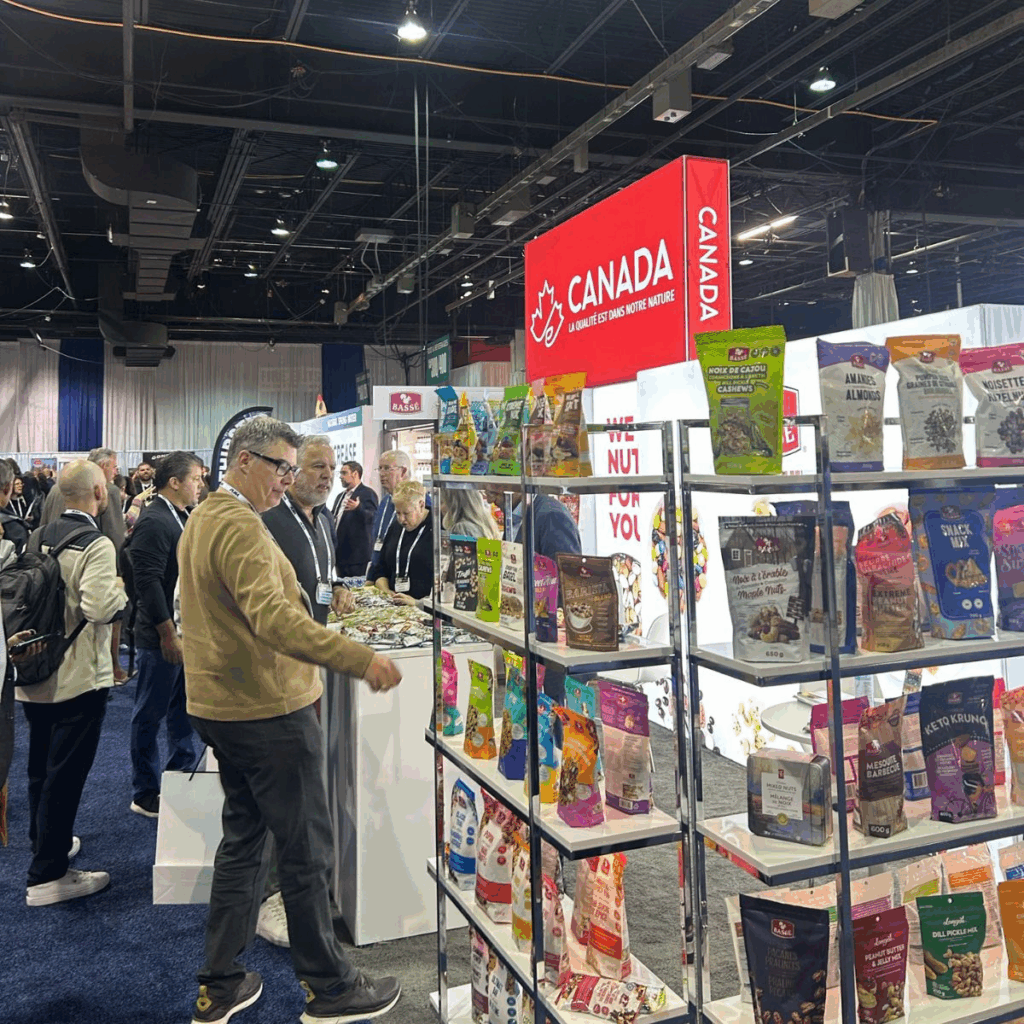
In conclusion, Marie-France Gibson emphasized the importance of visiting local stores during trade shows to observe market practices and innovations firsthand. She also encouraged PLMA Chicago participants to explore Amazon’s physical stores in Chicago, known for their competitive prices and innovative concepts.
To that effect, each year, Groupe Export organizes one of the largest Canadian pavilions at PLMA Chicago, held every November. More than forty companies will exhibit this year, in collaboration with Export Development Canada (EDC) and Inno-centre, partners of the pavilion organized by the association. Although all booths are now fully booked, it is still possible to attend as a visitor. Financial assistance from the Quebec Ministry of Agriculture, Fisheries and Food (MAPAQ) and Agriculture and Agri-Food Canada (AAFC) is also available to visitors.