


Sustainable Actions by Quebec’s Agri-Food Exporters Recognized by International Markets
As part of the Agri-Food Export Summit presented by Farm Credit Canada (FCC), Groupe Export Agri-Food was pleased to welcome Inno-centre and Léger to the stage to unveil the results of a study conducted among agri-food companies in Quebec. The survey shed light on the impact of climate change on exporters operating outside of Canada.
To provide an overview of Quebec’s agri-food processing sector, Inno-centre commissioned the research firm Léger to carry out the study between January 20 and February 19, 2025. A total of 131 executives from food processing companies participated. The findings were presented on June 17, 2025, in Brossard, during the Summit on Agri-Food Export, in front of nearly 200 attendees.
The study revealed that exporting companies are generally further along in their climate transition. Martin Lavoie, CEO of Groupe Export, emphasized the influence of international markets on agri-food exporters: “Customers, buyers, suppliers, partners, and even the export markets themselves are pushing processors to adopt more sustainable practices. In fact, 70% of the exporters surveyed indicated that new requirements from international buyers—primarily from Europe (37%) and the United States (33%)—are their main motivation. Implementing an effective ESG strategy is becoming a necessity, whether to diversify markets or to begin exporting.”
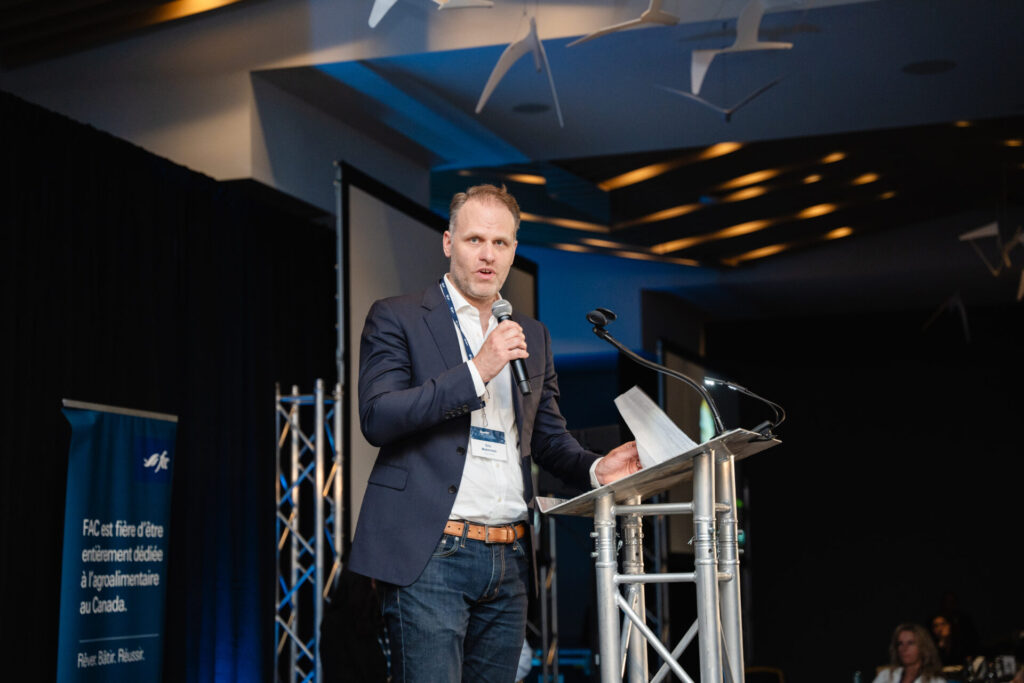
Éric Waterman, Vice President of Agri-Food at Inno-centre, stressed the importance of engaging in sustainable practices now:
“Today’s commercial instability, particularly from our southern neighbors, has pushed sustainable development requirements to the background. But this lull is temporary. Businesses should adopt a long-term vision and view reducing their carbon footprint as both a strategic lever and a competitive advantage.” He added, “Europe is aiming for carbon neutrality by 2050, and regulations will clearly move in that direction. The companies that succeed in export markets will be those that have already begun investing in GHG reduction.”
The survey also addressed carbon accounting, brand image, and barriers to undertaking sustainability initiatives. Key findings include:
- 58% of exporting companies surveyed have already conducted a carbon footprint assessment, compared to 28% of companies operating solely in the Canadian market—showing a clear willingness to go beyond regulatory requirements to structure their own actions.
- Enhancing brand image and reputation remains the top motivation for climate action, cited by 58% of exporters and 54% of non-exporters.
- The lack of skilled resources is a more significant barrier for 44% of internationally active companies.
Inno-centre’s support program for food processors is made possible thanks to financial support from the ministere de l’Agriculture, des Pêcheries et de l’Alimentation (MAPAQ) and of the ministère de l’Environnement, de la Lutte contre les changements climatiques, de la Faune et des Parcs (MELCCFP), as part of the Plan pour une économie verte 2030, and through collaboration with the Centre international de référence sur l’analyse du cycle de vie et la transition durable (CIRAIG).
*Léger cannot guarantee that the sample is representative of the population studied. No weighting was applied to the results. Furthermore, since no margin of error can be associated with a convenience sample, the findings cannot be extrapolated beyond this group.
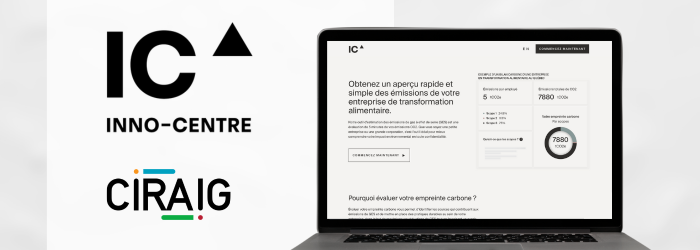
Inno-centre Tools – GHG Calculator
Get a quick and simple overview of your food processing company’s emissions. The Greenhouse Gas (GHG) Estimation Tool provides a five-minute assessment of your CO₂ emissions. Whether you’re a small business or a large corporation, this tool is ideal for gaining a better understanding of your environmental impact — all in complete confidentiality.
Contact Inno-centre
Éric Waterman, VP Agri-Food
eric.waterman@inno-centre.com